It is said that a picture is worth a thousand words. So, it naturally follows that four panels of a comic would convey the same information as roughly four thousand words of a story. However, no excerpt of that length would spend the entire time describing a single static situation. The story must transition from one segment to another. Comics must also transition from one segment to another. The Weekly Roll and Looking for Group both demonstrate a variety of techniques used to transition from one panel to another.

In the 53rd strip of The Weekly Roll by CME_T (Figure 1), the first panel shows a medium shot of the character, Becket, ringing a bell. The comic indicates that Becket is ringing this bell incessantly by showing a large number of small onomatopoeias of “ding.” This is followed by an action-to-action transition with the next panel of the shopkeeper placing his hand over the bell to stop the ringing. This second panel maintains Becket’s incessantness by drawing his speech bubbles over those of the shopkeeper, showing that Becket is speaking over the shopkeeper. The comic then transitions to the third panel by using a scene-to-scene transition. The second panel has the shopkeeper make mention of the danger of werewolves attacking the town, and the third panel shows a werewolf attacking the town. No incorporated text appears in this third panel, but it serves an important role in indicating the passage of time between the second panel and the fourth panel, where the final action happens. The third panel transitions into the fourth with a subject-to-subject transition. The werewolf is still present in the frame and is still in roughly the same position as the third panel, indicating that very little time has passed between these two panels. However, the focus is now drawn to Becket and him getting ready to hit the werewolf with a sock filled with silver coins. While the object that Becket is holding might not be obvious just from the drawing, it is implied by the dialogue in the second panel where Becket requests silver coins and a sock from the shopkeeper.
CME_T maintains consistency through this entire strip by keeping the drawings as a medium shot for all four panels. The choice of a medium shot also serves to convey a degree of intimacy between Becket and the shopkeeper as well as between Becket and the werewolf. It may be an antagonistic and violent kind of intimacy, but it is intimacy. This consistency and intimacy provided by the consistent shot type helps tie together the panels despite each transition using a different transition type. Otherwise, the comic might begin to feel disconnected. However, there are situations where making the panels feel disconnected from each other may be the artist’s goal.
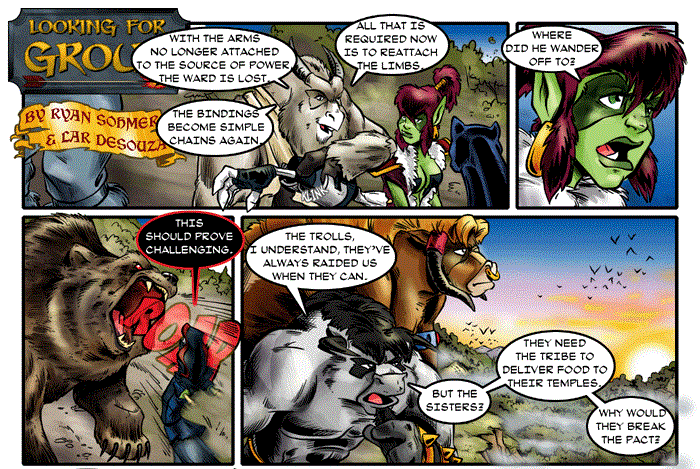
In the sampled excerpt from Looking for Group by Sohmer and DeSouza (Figure 2), the movement of the plot demands a transition from the first panel to the fourth panel. However, a problem emerges with this transition. A transition directly between these panels would be a scene-to-scene transition. The problem is that both of these panels are medium shots of characters having a slow conversation that is heavy in plot and worldbuilding exposition. It has also been established on previous pages that the characters involved in both conversations are in roughly the same location. So, while the comic requires a scene-to-scene transition, a direct change from the first panel to the fourth panel could be confusingly misinterpreted as a subject-to-subject transition within the same scene.
To counteract this potential confusion, the artist has included the second and third panels. The transition between the first panel and the second panel uses a subject-to-subject transition and changes the shot type to an extreme close-up of the character, Benny. This close-up serves to highlight the confusion and exasperation on Benny’s face, but it also serves to break up the flow of a slow conversation at a medium shot. The second panel then transitions to the third panel with a non-sequitur and switches to a wide shot. Scott McCloud describes the non-sequitur as a transition “which offers no logical relationship between panels” (72). There is an argument for there being some logic to this transition. The first panel references a man missing his arms and then the second panel has Benny wondering where this man has gone. Thus, the third panel showing Richard, a man without arms, follows a sort of logic. However, no explanation is offered as to exactly where Richard has gone, why he would wander off without his arms, where he found a bear, or why he is more intrigued than frightened by facing a bear while he has no arms. As McCloud says, “such transitions may not make ‘sense’ in any traditional way, but still a relationship of some sort will inevitably develop” (73). A reader who has been following the rest of the comic can develop a tight closure within this transition by having a more nuanced understanding of the character than just what is provided in these panels. Ultimately, the main logic of this transition is that Richard is an inherently illogical character.
The third panel then transitions to the fourth panel with another non-sequitur transition, returning to the same kind of calm conversation at a medium shot, which conveys plot and worldbuilding details that the first panel had. However, now the fourth panel is clearly a separate scene from the first panel. The dynamic changes in shot type and non-sequitur transitions are punctuated by the high-energy nature of the third panel to create a distinct barrier between the first and fourth panels. In effect, the second and third panels provide an especially bold gutter to mark a clear scene-to-scene transition between the first and fourth panels.
By making use of the wide variety of tools that different kinds of shots and transitions provide, these artists have been able to convey a wide range of meanings within a relatively short space. In these particular excerpts, The Weekly Roll and Looking for Group display techniques that are the antithesis of each other. One deliberately enhances the connectivity between the panels while the other deliberately breaks that same connectivity. However, both choices are right for the situation they are in and serve to enhance, rather than detract, from the story as a whole.
Works Cited
CME_T. “Ch. 53. Keep the change, you filthy animal.” /r/TheWeeklyRoll, Reddit, 10 Oct. 2020, reddit.com/r/TheWeeklyRoll/comments/j8t0p1/ch_53_keep_the_change_you_filthy_animal/.
McCloud, Scott. Understanding Comics: The Invisible Art. HarperPerennial, 1994.
Sohmer, Ryan and DeSouza, Lar. Looking for Group, p. 134, 27 Mar. 2008, www.lfg.co/page/134/.
 Crayshack